
Hi, I’m Sophie.
I got into NYU with a 3.2 GPA. No test scores, no clubs, no honors, and one extracurricular.
What set me apart was my essay. It captured who I am, where I come from, and what I stand for, in a way no other applicant could have written.
Now I help students do the same.
Your story matters more than your stats!
A transcript shows your grades, an activities list shows what you’ve done, and recommendations show how other people see you.
But your essay shows how you think.
It is the only place in your application where the admissions officer gets sustained access to your own mind. They get to see who you are beyond everything else on the page and separate you from the rest of the pool.
The best essays leave a reader understanding: what you notice, what matters to you, what your thought process is, how you make sense of your experiences, what assumptions you’ve challenged, and how you’ve changed.
That’s why the question isn’t “Is this a good story?” It’s “What does this story help the reader understand about me?”
A lot of students lose sight of this. They try so hard to impress admissions officers that their actual personality disappears from the writing. Or they spend so much time explaining what happened that the reader never gets to understand the person it happened to.
You can write a technically beautiful essay and still leave the reader knowing almost nothing meaningful about you. And memorable does not mean dramatic.
One student can write about winning a championship, losing someone they love, or moving across the world and still sound like hundreds of other applicants. Another can write about a scratched kitchen table, a box of colored pencils, or a five-minute conversation and reveal an entire way of seeing the world.
Your topic doesn’t need to be unique or mind-blowing, but your perspective does!
So ask yourself: What have you lived, noticed, questioned, struggled with, or loved that changed the way you see yourself, other people, or the world around you?
Ultimate College Essay Rulebook
A clear path from a blank page to a finished essay, with which chapters to use at each step, about how long each one takes, and how you’ll know you’re done
The five ways essays quietly fail, and how to tell which one your draft is closest to
40 story-mining prompts to find the moments you’d never think to write about
Topic guides for the most common essay subjects (sports injuries, grandparents, moving, culture, service trips, failure and more), with the angles that actually stand out
A step-by-step way to turn a broad topic into an insight only you could write
The Depth Ladder: eight questions that take you past “it taught me perseverance” to what your story really means
How to prove your growth instead of just naming it
A blueprint for building your essay, plus specific techniques for openings, the middle, the turning point and endings
A full model essay with my notes on why each part works
Watch Me Edit: one essay taken from first draft to final, with my real-style comments at every step
The Label-Word Dictionary, which shows what words like “resilience” and “passion” are hiding and how to replace them
The Red-Flag Library: 40 phrases and patterns that weaken an essay, with the question to ask instead
Word count surgery that shows you how to cut without losing what makes the essay yours
A final audit checklist to run before you hit submit
Guidance on supplemental essays, including how to write a “Why us?” essay that couldn’t be sent to any other school
A straight answer on AI: what schools say, and how to use it without risking your application
A chapter for parents on how to help without taking over
A workbook with an “If You’re Stuck” guide, reflection journal prompts and a progress tracker
A complete 115 page step-by-step PDF guide with 42 chapters, written exercises, before and after examples throughout, and MORE!
Perfect for students starting from scratch, students with a draft that feels generic, and anyone who wants to understand what makes an essay memorable and exactly how to accomplish that.
What’s Inside:
Essay Diagnosis Package
One complete, in-depth round of feedback in your own Google Doc. You’ll know exactly what’s working, what isn’t, and exactly how to fix it. What’s included?
A uniqueness read. Before I comment on a single sentence, I read your whole essay the way an admissions reader would and write you a summary:
Where you show up: the sentences only you could have written, quoted so you know what to protect
Where you disappear: the sentences any applicant could have written
The thread I see in you: what your details reveal about how you think and what you value
What your essay is really about underneath the topic
The biggest fix that would do the most for your essay
Thorough line-by-line comments throughout your essay, timestamped in Google Docs so you can see exactly what I said and when. Each comment is tagged by priority. Fix the Big ones first, and ignore Polish until they’re done.
Big: structure, depth, missing reflection, and anything that changes what the essay is about
Medium: specificity, label words, clarity, and flow
Polish: word choice and rhythm
Every weak spot flagged, with a question to fix it. I don’t just say “be more specific.” I point to the sentence, name the problem, and ask a question you can answer:
“Another applicant could paste this in unchanged. What did this experience actually look like? Give me one moment, and paint it in a way nobody else can.”
“‘Resilience’ is doing the work that a moment should do. What specifically changed in how you think?”
“This stops at what happened. What did you believe before that turned out to be wrong?”
Clichés like “Ever since I was young” or “now I make my own luck,” with what to ask yourself instead
I highlight your best sentences and tell you why they work, so you build on them instead of cutting them when you revise.
Spelling, grammar, punctuation, and awkward phrasing, corrected as tracked suggestions in Suggesting mode. You see every change and accept or reject each one.
Whether your essay actually answers the prompt you were given, and where your word count is going: what’s earning its space and what isn’t.
A revision roadmap. A plan for your revision in the order to do it, so you aren’t staring at your comments wondering where to start. Example: “1. Cut paragraph two. 2. Expand the moment in paragraph three. 3. Rewrite your ending. 4. Then handle the Polish comments.”
Guided reflection questions aim at what you haven’t said yet, the material that turns a good draft into a memorable one. These aren’t copied from a template, each is written for your story.
The Checkup tells you what’s holding your essay back. The Diagnosis goes through your essay line by line, the way I’d mark it up for a student I’m working with one-on-one, and shows you exactly what to do next.
Please Note: before you book, this service is for complete drafts. You’ll need a full written essay, beginning to end, near your word limit. It doesn’t need to be “good” yet.
Admissions decisions depend on the whole application. I can’t promise results, but I can help you submit your strongest essay.
Essay Transformation Package
Everything included in the Essay Diagnosis (Round 1), followed by two more thorough reviews of your revisions. I’ll guide you every step of the way through this complete, multi-round transformation.
Round 2: Once you’ve revised, I dissect the entire essay again and tell you what worked, what didn’t, and what your writing needs next. This is where the real transformation happens.
Before you send it: Revise in the same Google Doc, so your comments and version history stay together. At the top, add a short revision note covering what you changed, what you’re unsure about, and any comment you disagreed with or didn’t know how to fix.
I’ll provide an updated version of your “uniqueness read”, comparing this draft to the first:
What’s now working that wasn’t before, quoted so you can see the difference
Whether the main change from round one actually did what it needed to
Where you show up now: new sentences only you could have written
Where you still disappear: what’s still generic, or what slipped back in
What your essay is about now: whether the one-sentence core got sharper, or shifted
Structural recheck: Revisions often fix one thing and move another. I check the whole shape again:
Your turning point: whether it’s now earned, slowed down, and placed where the essay can build to it
Your depth: whether the essay now reaches what you believed, what you got wrong, and what changed
Your arc: whether the reader can feel the difference between the beginning and the end
Your balance: whether the moment that matters has the most room, and whether setup or summary is eating your words
Opening workshop: Now that your structure is in place, we find the right way in:
Where your essay should actually start, which is often later than in your first draft
2-3 ways in, such as starting with an action, a specific image, or a thought, each with an explanation of what it would do for your essay
Whether your current opening makes a promise the rest of the essay keeps
Ending workshop:
What your current ending is doing: summarizing, explaining, announcing a lesson, or landing
What it could do: return to an image, object, or idea from your own essay with changed meaning, or show a present-day action that proves the growth
Your last sentence test: whether the essay gets stronger without it
New line-by-line comments on the new draft, tagged Big, Medium, or Polish:
On everything you changed, including whether the new sentences are as specific as they can be
On anything still unresolved from round one
Every new weak spot flagged with a question to fix it, including the swap test, label words, depth checks, and red flags
Your strongest new lines marked
Mechanics fixed as tracked suggestions
A short explanation with every major comment of why it matters. By round two, you’ll start noticing these patterns yourself, which is the point. Example: “Notice that every time you explain a feeling after you’ve shown it, the scene loses force. Trust the reader here.”
I respond to every question you may have. If you pushed back on a comment, I’ll either explain my reasoning more clearly or agree and adjust. It’s your essay.
An updated roadmap: A new, shorter numbered plan for your final revision, with any new guided reflection questions your draft needs.
Round 3: One last full read before you submit. I’ll tighten every line, cover all of the little things, and make sure your essay will make an impact.
Before you send it: Revise in the same doc and add a short note covering what you changed and anything you’re still unsure about.
Final line-by-line polish: A careful, sentence-level read of the whole essay:
Rhythm and flow: sentences that drag, repeat a structure, or break the reader’s momentum
Transitions: whether each paragraph earns the next, without stiff phrases like “Furthermore” or “In conclusion”
Word choice: anything inflated, vague, or not how you’d actually say it
Last-minute slips: generic lines or red flags that crept back in
Mechanics: a final pass on spelling, grammar, and punctuation, as tracked suggestions
Prompt fit: your essay answers the prompt you were given
Word count: within the limit, with a cut plan if you’re over (what to cut, and what to protect)
Voice: it sounds like the clearest version of you, not a thesaurus or an essay template
Opening and ending: the opening pulls the reader in, and the ending lands without summarizing
Could anyone else have written this?
What will the reader remember about you ten minutes later? What’s the most revealing sentence?
Anything a reader would stumble on
A short closing note on where your essay ended up, what makes it yours, and anything I’d still watch for. If something still needs work, I’ll say so plainly, so you can decide whether to fix it before submitting.
Please Note: before you book, this service is for complete drafts. You’ll need a full written essay, beginning to end, near your word limit. It doesn’t need to be “good” yet.
Admissions decisions depend on the whole application. I can’t promise results, but I can help you submit your strongest essay.
Essay Checkup
A fast, honest read on whether your essay is working.
You’ve written a draft, or you have a topic you can’t stop second-guessing, and you need to know if you’re on the right track before you put in more hours. I’ll read your essay the way an admissions reader would and tell you what I’d tell you if we were sitting across a table: what’s working, what’s holding it back, and where to start.
What you’ll get:
Your strongest moment. I’ll point to the line or detail that sounds most like you and explain why it works, so you know what to protect and build on.
The one thing holding it back. Most drafts have one main problem underneath all the small ones. It might be an essay that reads like a résumé, a lesson that’s told instead of shown, a story that’s really about someone else, or an ending that sounds like a poster. I’ll name yours and explain why it matters.
Where to start. The first change I’d make, before you touch anything else, so you’re not stuck revising sentences when the real issue is bigger.
The uniqueness check. My honest answer to whether this essay could only have come from you, plus where you show up on the page and where you disappear behind general statements.
A few guided questions written for your story. This is what I’d ask you to get to the deeper meaning. Students’ best sentences usually come from answering them.
How it works: After you book, I’ll email you to get a copy of your essay. You’ll get about ½ to 1 page of written feedback within 1 week.
It’s a good fit if:
You have a draft and something feels off, but you can’t tell what
You’re choosing between topics and want an outside opinion
You’ve revised so many times you can’t see your essay clearly anymore
You want to see how I give feedback before committing to more
What it doesn’t include: line-by-line in depth comments, grammar and spelling corrections, or a second round. It’s a big-picture read meant to point you in the right direction.
Testimonials
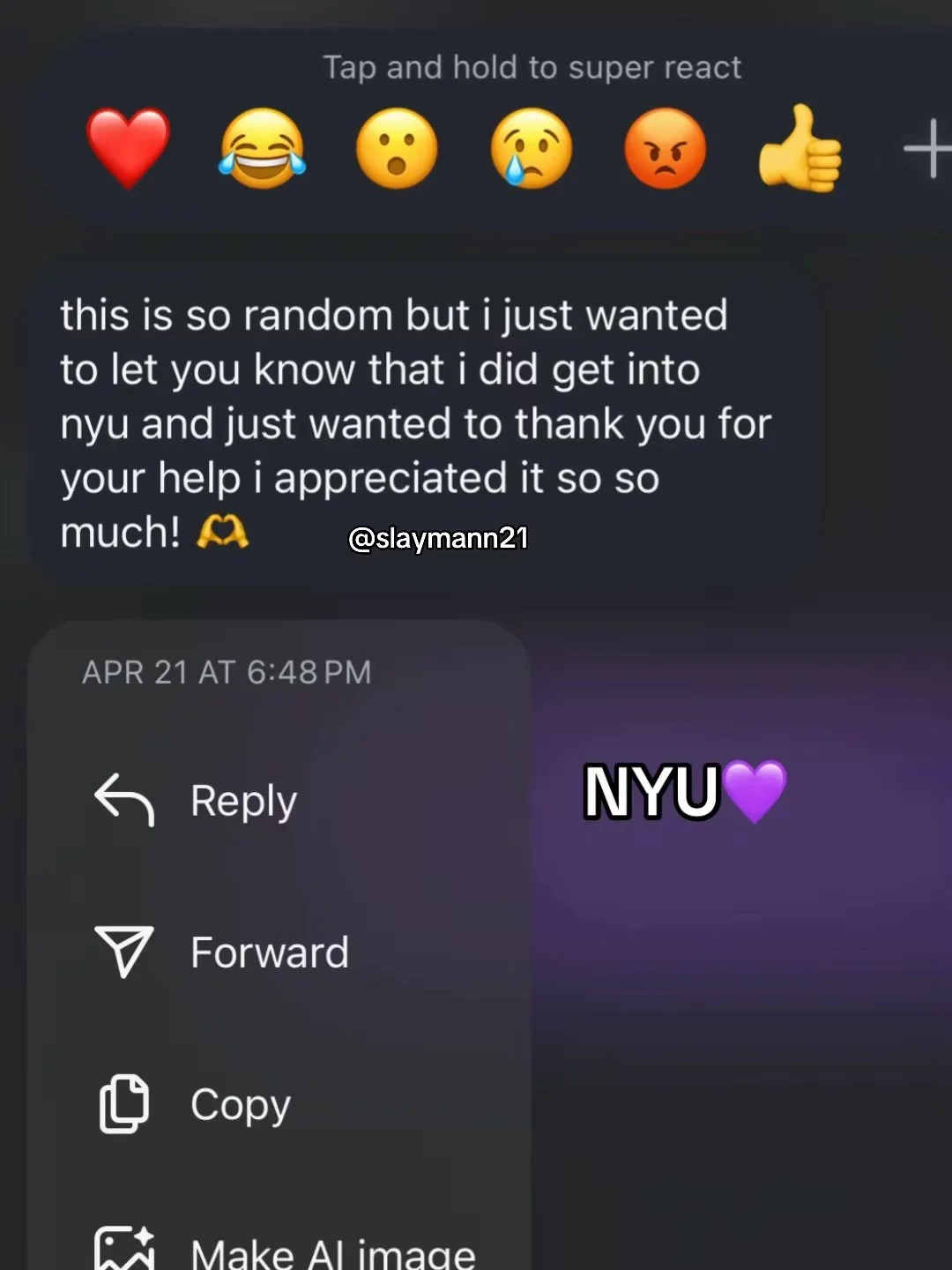
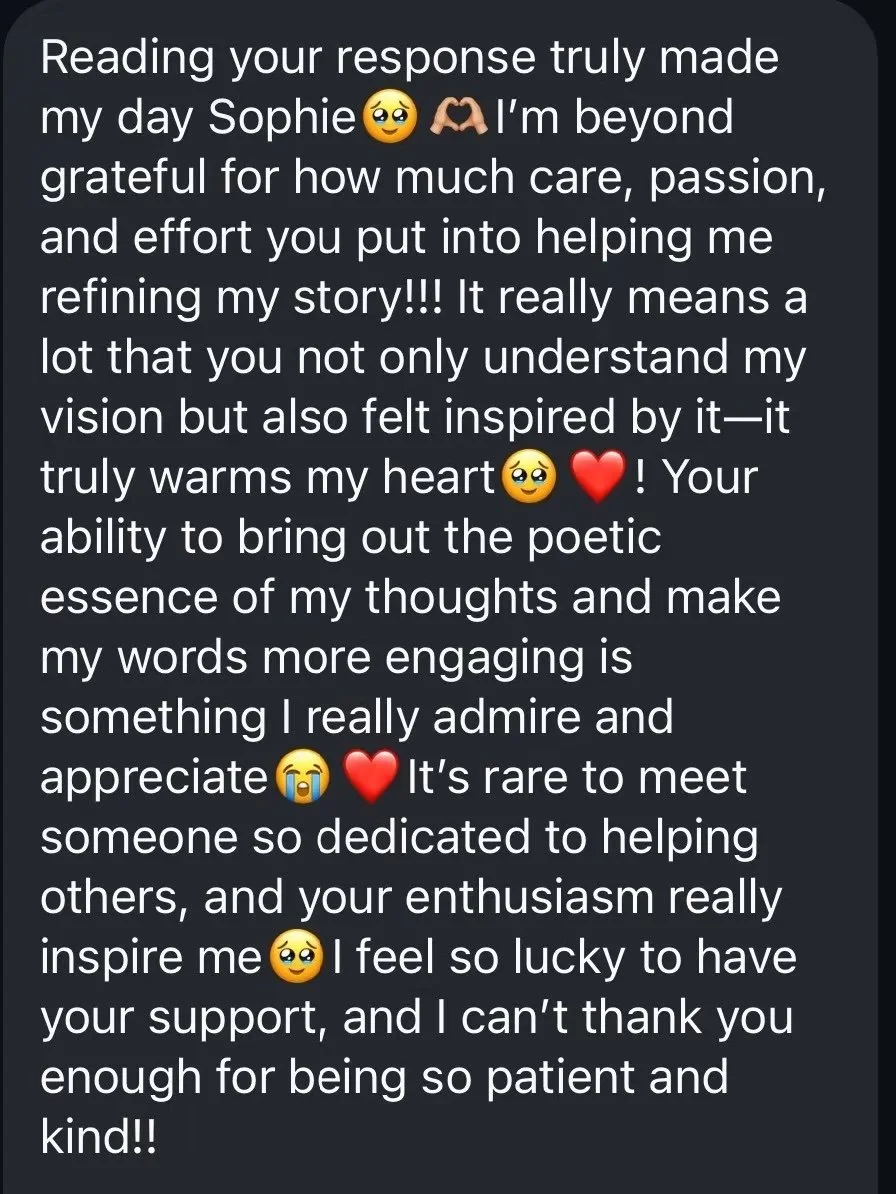
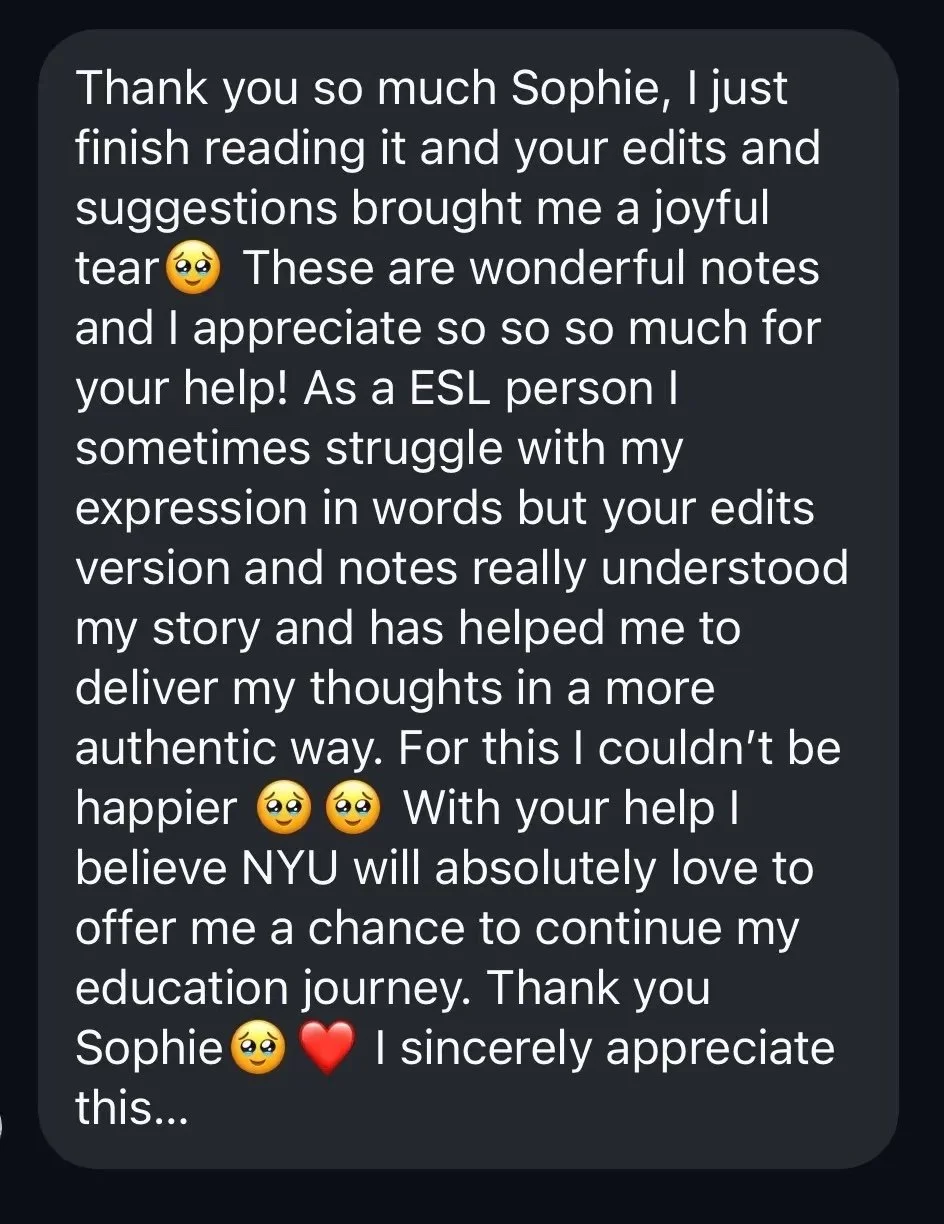
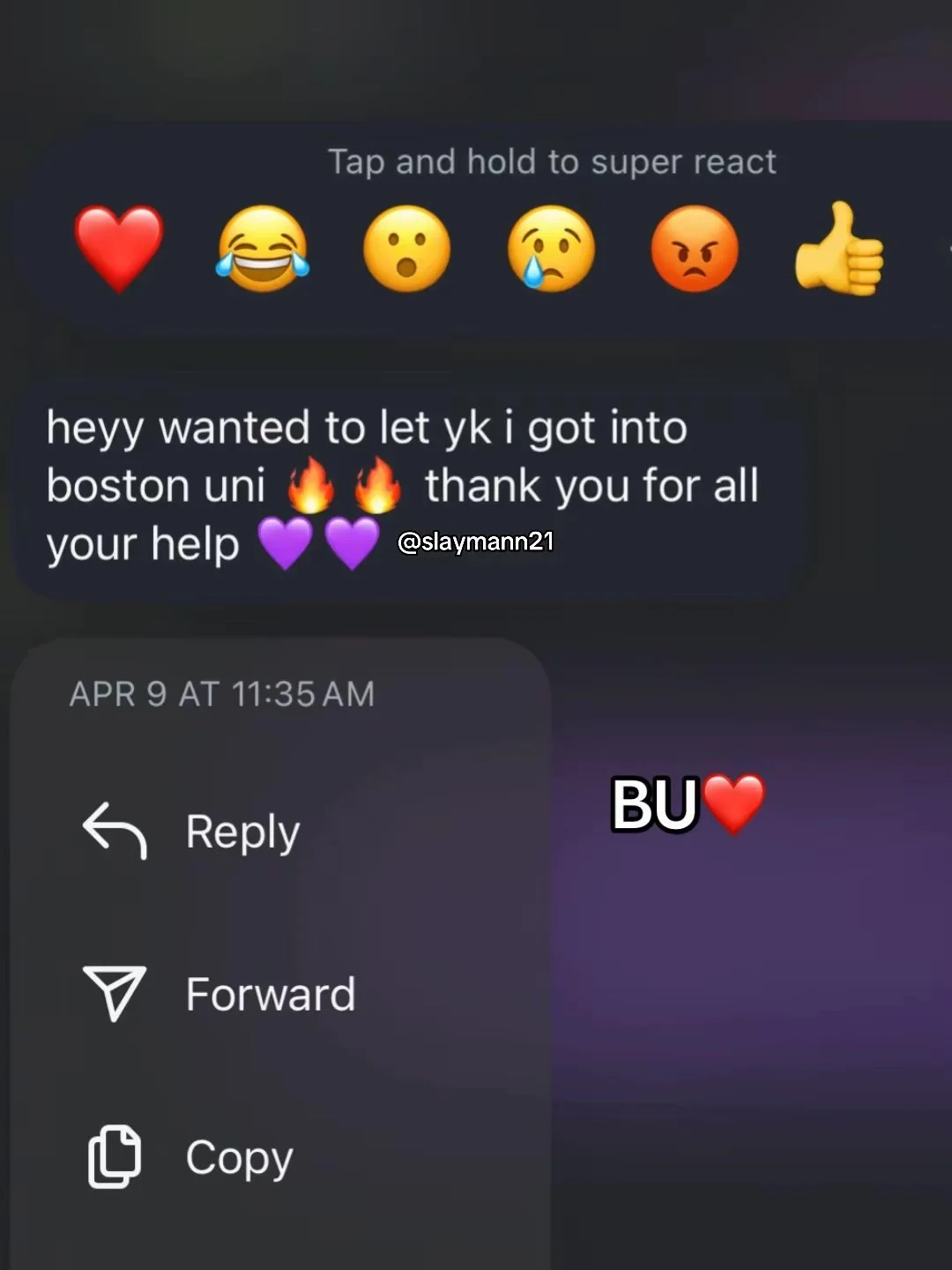
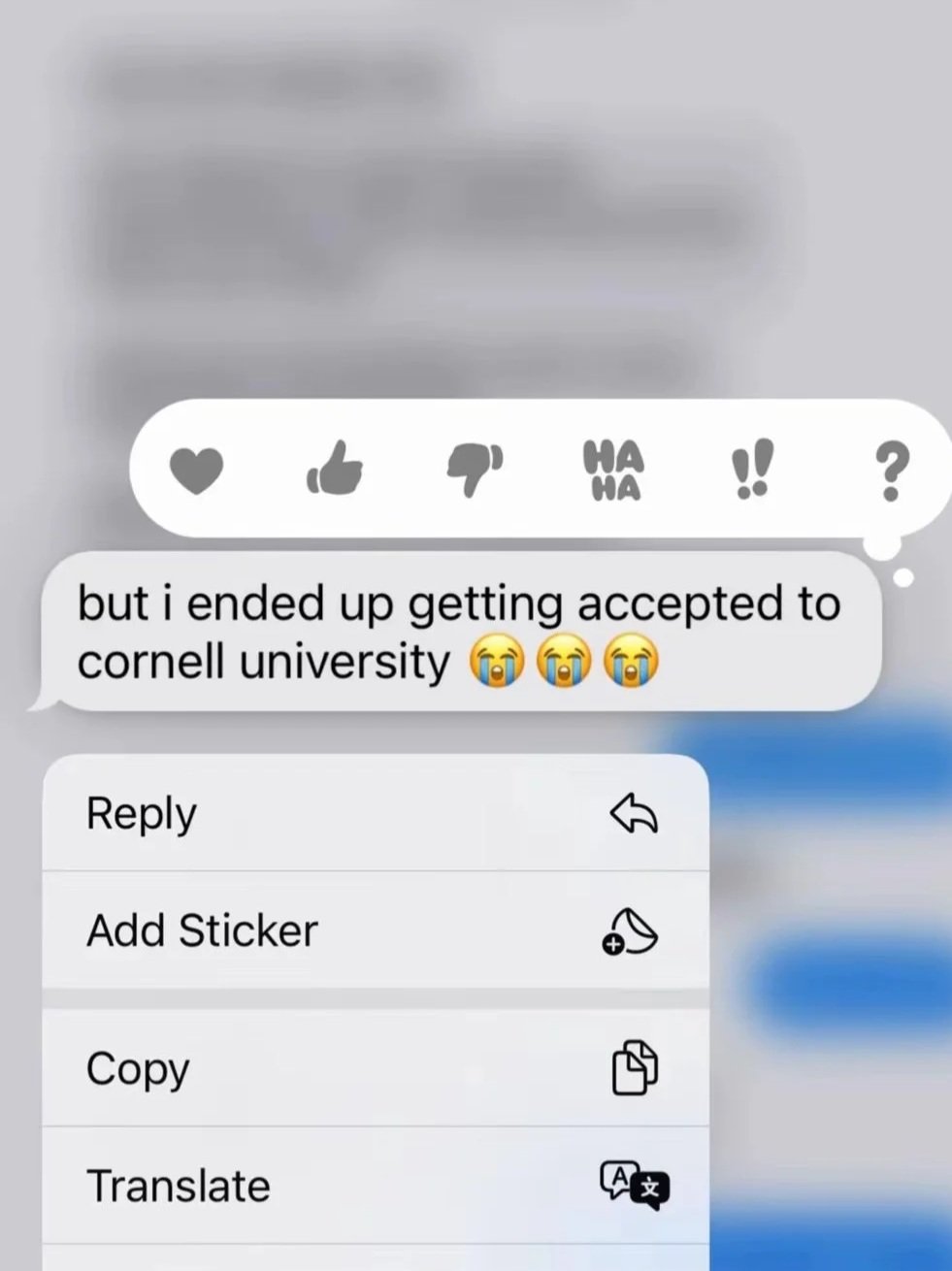
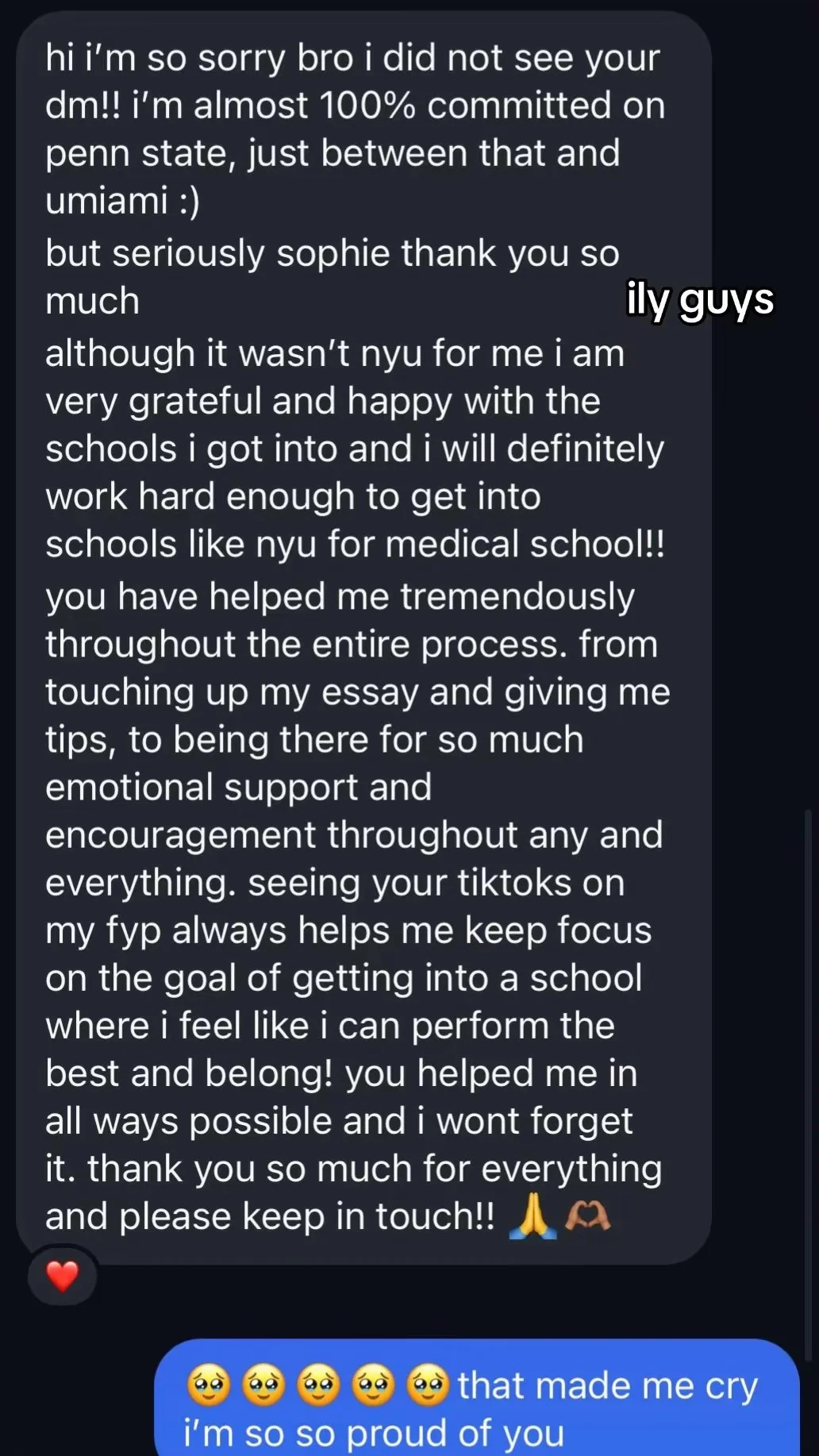
Why work with me when Google and AI exist?
There is more college essay advice available online than ever before. You can search for the “best college essay topics,” ask AI to rewrite a paragraph, or find hundreds of examples of essays that worked. It can tell you to “show, don’t tell.” It can tell you to be vulnerable, demonstrate growth, use specific details, and start with a strong hook.
But knowing those rules and knowing where your own essay is falling short are two very different things. And none of that replaces having an experienced person read your essay closely, ask the questions you haven’t thought to ask yourself, recognize what is missing, and push you deeper while protecting your own voice. That’s where I come in.
I’ve worked with hundreds of students and read essay after essay at every stage of the process. I know what it looks like when an essay has a great story but stays too surface-level. I can tell when the most interesting part of a student’s story is buried in one sentence they almost overlooked. I notice when the writing sounds impressive but doesn’t actually reveal the person behind it, when a lesson feels forced, when a paragraph could have been written by any applicant, or when a student is explaining the wrong part of their story.
My job is to find what is already interesting about you and help you bring more of it onto the page. Every essay I review and help edit is done personally by me. You’re getting my eyes, my judgment, and feedback specific to your story and writing.
The Most Common First-Draft Mistakes
I see these in almost every first draft. Each one has a fix.
The résumé essay. A walkthrough of an activity or award. Fix: find one moment inside it that shows how you think.
The lesson is told, not earned. “This taught me resilience.” Fix: show the moment and let the reader reach the word.
The essay is about someone else. Three paragraphs on your grandmother, one on you. Fix: keep asking what the relationship reveals about you.
Pain without reflection. A hard experience told in detail, with little about your thinking. Fix: ask what it revealed about your choices and beliefs.
Generic claims. “I’m passionate about helping others.” Fix: replace the label with evidence so specific the reader could name the quality.
Open your essay and run these three tests:
The swap test. Pick any sentence. Could another applicant paste it into their essay unchanged? If yes, it isn’t doing its job yet.
The human-being test. After reading your essay, could someone describe how you think, not just what you did?
The depth test. Does your essay stop at what happened? Or does it reach what you believed, what you got wrong, and what changed?